
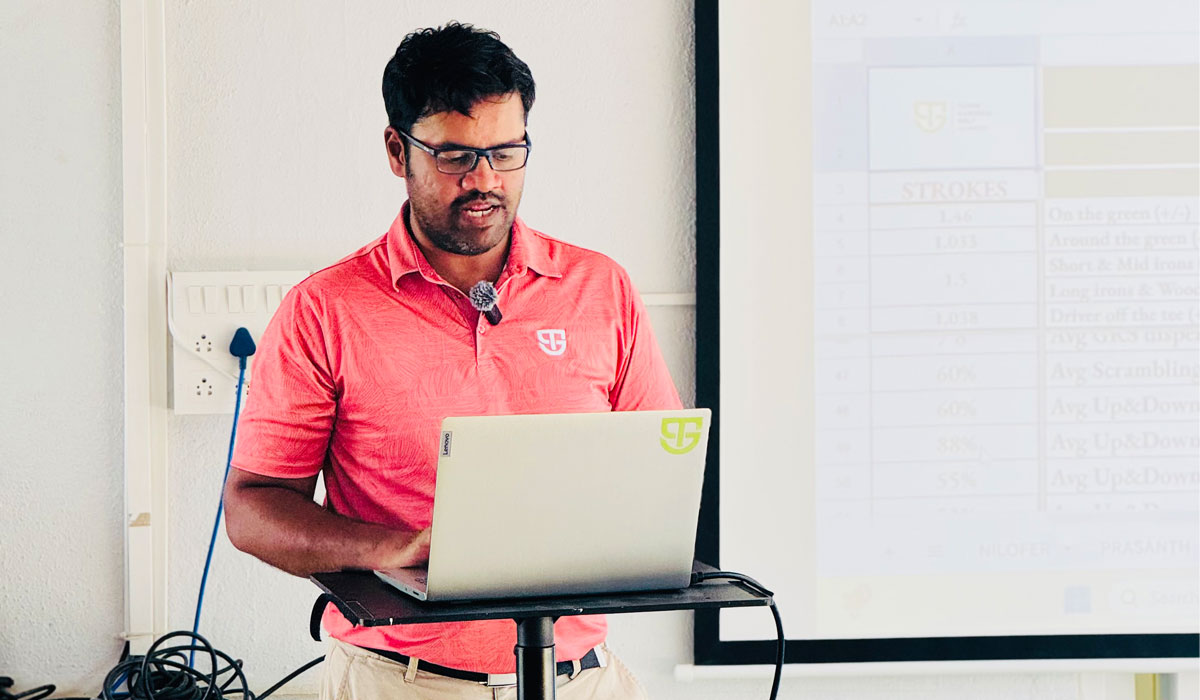
Head coach Prithviraj Ram gave the players a thorough analysis of PGA Tour statistics during one of the most recent player meetings at TSG, helping them understand what actually constitutes excellent performance at the top level. His address clarified how consistency, judgment, and poise allow even the world’s top players to score even when they miss a few fairways and short putts.
At TSG, one of the most essential learning imparted during these sessions is the significance of realising what constitutes successful performance. At this meet, players started to perceive the game more clearly by comparing their own data with PGA Tour benchmarks. This helped them see the game as a path of steady, informed growth rather than as a race for perfection.
Rethinking Golf Expectations
Golfers frequently have irrational expectations of themselves. It can feel like a lost chance when a green is missed or a wedge approach from 100 yards fails to land within eight feet. The averages, however, provide a very different picture when you examine the PGA Tour numbers.
Seldom do the best players in the world get every shot near. On the PGA Tour, the average distance to the hole is about 20 feet between 100 and 120 yards. It is roughly 17 feet from 80 to 90 yards and 16 feet from 30 to 60 yards. Even the top players don’t always stay close to the green; on average, they are still about eight feet away.
What is the takeaway?
It’s not always a sign of poor performance to miss the target or leave a chip longer than anticipated. Instead, it indicates that you are human because even the greatest sportsmen in the world have experiences similar to yours.
Gaining Knowledge from PGA Tour Averages
Despite the typical PGA Tour scoring average being approximately 71, Coach Prithvi revealed that these players are continually improving their performance by gaining strokes in specific areas. Players at TSG are better able to adjust their own expectations when they are aware of these benchmarks.
Let’s examine some significant findings:
- Scrambling: About 60% of the time, tour pros can get up and down. In other words, they fail four times out of ten.
- Putting: The make percentage is approximately 88% from 3 to 5 feet, but it falls precipitously to 56% from 5 to 10 feet and barely 30% from 10 to 15 feet.
- Driving Accuracy: Even the world’s top drivers don’t hit every fairway. They miss about one out of every three fairways, averaging between 65 and 70 percent.
- Greens in Regulation (GIR): Players on the PGA Tour hit around 6.5 out of every ten holes, or 65% of greens.
These figures demonstrate how dispersion, misses, and poor shots affect even the best golfers.
The way they handle these situations and bounce back is what makes a difference.
Recognising Gained Strokes and Consistency
Strokes Gained, a measure of how much better or worse a player performs in relation to the field average in many elements of the game, is one of the most illuminating current golf statistics. For instance, top players like Scottie Scheffler gain about 1.46 shots every round simply by putting.
Strokes Gained- Around the Green:
Averages roughly one shot, demonstrating the importance of effective pitching and chipping.
Strokes Gained- Approach:
Once more, about 1 to 1.2 shots, emphasising the significance of accurate iron play.
Strokes Gained- Off the Tee:
Each round, accuracy and distance add up to about 1 shot.
This data demonstrates that being flawless in every area is not necessary for success. Instead, it results from maintaining consistency throughout four rounds while obtaining minor advantages in other areas.
Driving: Juggling Accuracy and Distance
Driving performance was one of the main takeaways from the conversation. Many emerging golfers believe that longer drives inevitably yield better outcomes, but accuracy is still just as important.
According to tour data, players who regularly perform well combine controlled precision with an average driving distance of more than 300 yards. A player can gain strokes off the tee and lessen pressure on their approach shots by striking a balance between distance and control. Additionally, this balance eliminates the need for recovery play and increases scoring possibilities.
Approach Opportunities for Play and Scoring
Top players frequently set themselves apart from the rest with approach shots. PGA Tour golfers often leave the ball 28 feet from the hole between 150 and 160 yards.
Additionally, according to tour data, players who are closest to the hole routinely score highly in Strokes Gained: Approach, which has a direct impact on their average score. Knowing this makes it easier for aspiring golfers to focus on improving their averages rather than trying to make every shot “perfect.”
Putting and the Short Game: Where Rounds Are Won
The majority of golfers lose strokes on and around the green, which calls for dexterity, touch, and confidence, according to Coach Prithvi.
Because they invest time in honing their short-game skills, top players get the most shots in these zones. Creating dependable patterns and being composed under duress are more important than technical excellence.
Instead of relying solely on repetition, players at TSG are encouraged to use their brief gaming sessions to develop feel and adaptability. A realistic approach to results and a composed, self-assured mind make all the difference when it comes to scoring.
The Modern Game’s Balance
Tour data analysis also demonstrates that balance is key to success in modern golf. To compete at a top level, a player doesn’t have to be the best in every metric.
Despite not being long hitters, certain players, like Luke Donald, rose to the top of the world rankings. His superior scrambling, putting, and approach play made up for his shorter drives. However, players with exceptional long-game performance, such as Scottie Scheffler, dominate and relieve pressure on other areas.
The takeaway?
Focus on your strengths, be aware of your shortcomings, and strive for consistent progress in all areas rather than just one.
The TSG Method for Developing Smarter Golfers
Golf is a game about controlling expectations and playing to your abilities, not striving for perfection, as Head Coach Prithviraj Ram’s session taught players. Players discovered, by analysing PGA Tour statistics, that consistency, alertness, and poise are more critical to the world’s top players than perfect execution.
TSG makes sure that every player knows why something occurs before focusing on how to correct it, whether it’s increasing closeness, decreasing three-putts, or learning more intelligent course management.
The objective of the entire TSG team is to develop intelligent athletes who understand their game, make better choices under pressure, and gradually progress towards long-term excellence rather than simply producing skilled golfers.
Happy Golfing!